Is an area situated on the north-western shore of the Sea of Galilee. It is traditionally accepted as the place of the miracle of the multiplication of the loaves and fishes (Mark 6:30-46).
Church of the Multiplication
The earliest building at Tabgha was a small chapel built in the 4th century A.D. (around 350) by the Jewish convert to Christianity, Joseph of Tiberias. According to Epiphanius, Joseph was a contemporary of Emperor Constantine, a Rabbinical scholar, member of the Sanhedrin and a disciple of Hillel II. Following his conversion, Emperor Constantine gave him the rank of count (comes), and gave him permission to build churches in the Galilee, specifically, in Jewish towns which didn't yet have a Christian community, and the Galilee including the Sea of Galilee, was an area with a Jewish majority. This was probably the shrine described by the pilgrim Egeria at the end of the 4th century. The 4th century small shrine was dismantled in 480 and a bigger chapel was built by Martyrius of Jerusalem, Patriarch of Jerusalem from 478 to 486. Martyrius was Egyptian by origin, and this may be the reason why the floor of his chapel was covered with a beautiful Nile mosaic, a style of art popular in the Byzantine time, describing Nilotic landscape and the fest of the Nile.
The mosaic of the fish and loaves is laid next to a large rock, which has caused some New Testament scholars to speculate that the builders of the original church believed that Jesus stood on this rock when he blessed the fish and loaves just before the feeding of the crowd who had come to hear him.
Church of the Primacy of St. Peter
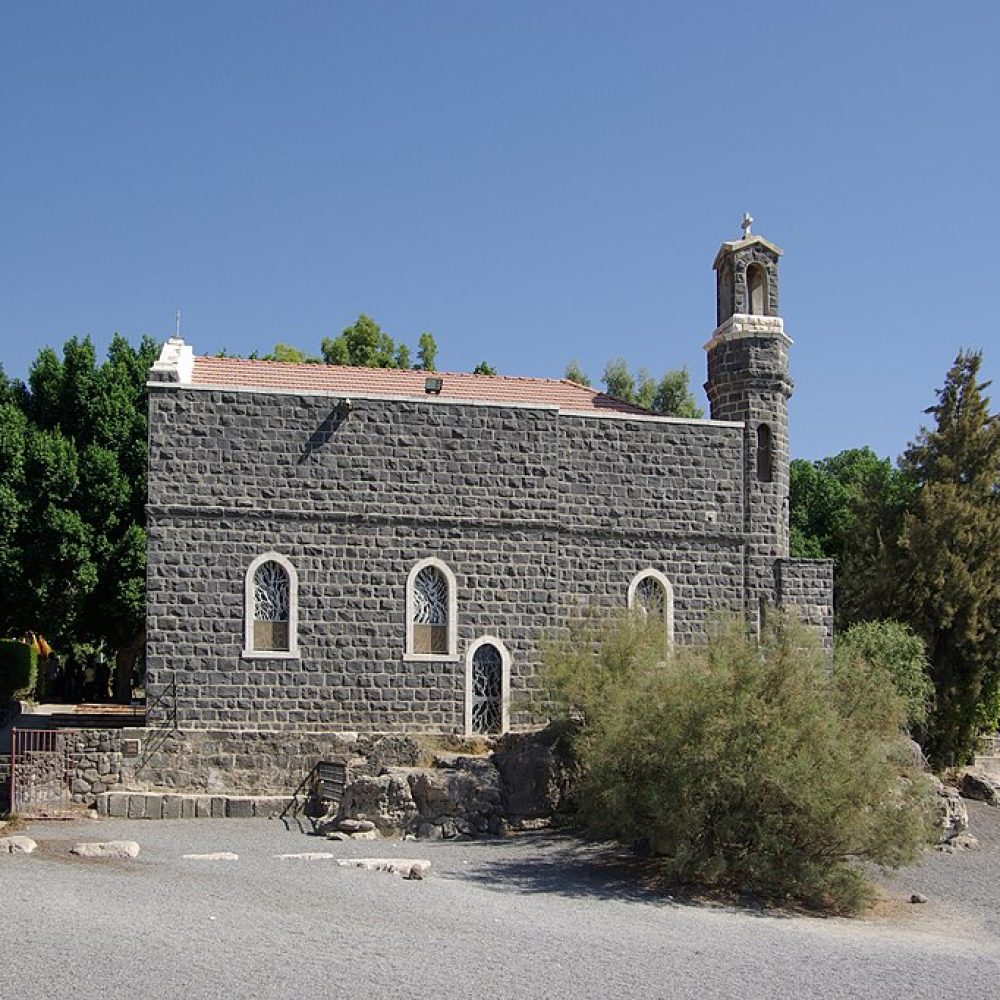
The Church of the Primacy of St. Peter, just south of the Church of the Multiplication, was built on rocks at the shore of the Sea of Galilee, traditionally considered to be the place where Jesus appeared the fourth time after his resurrection (John 21:1–24), during which, according to Catholic teaching, Jesus again conferred primacy on Simon Peter.
 Holy Land Bible Tours.