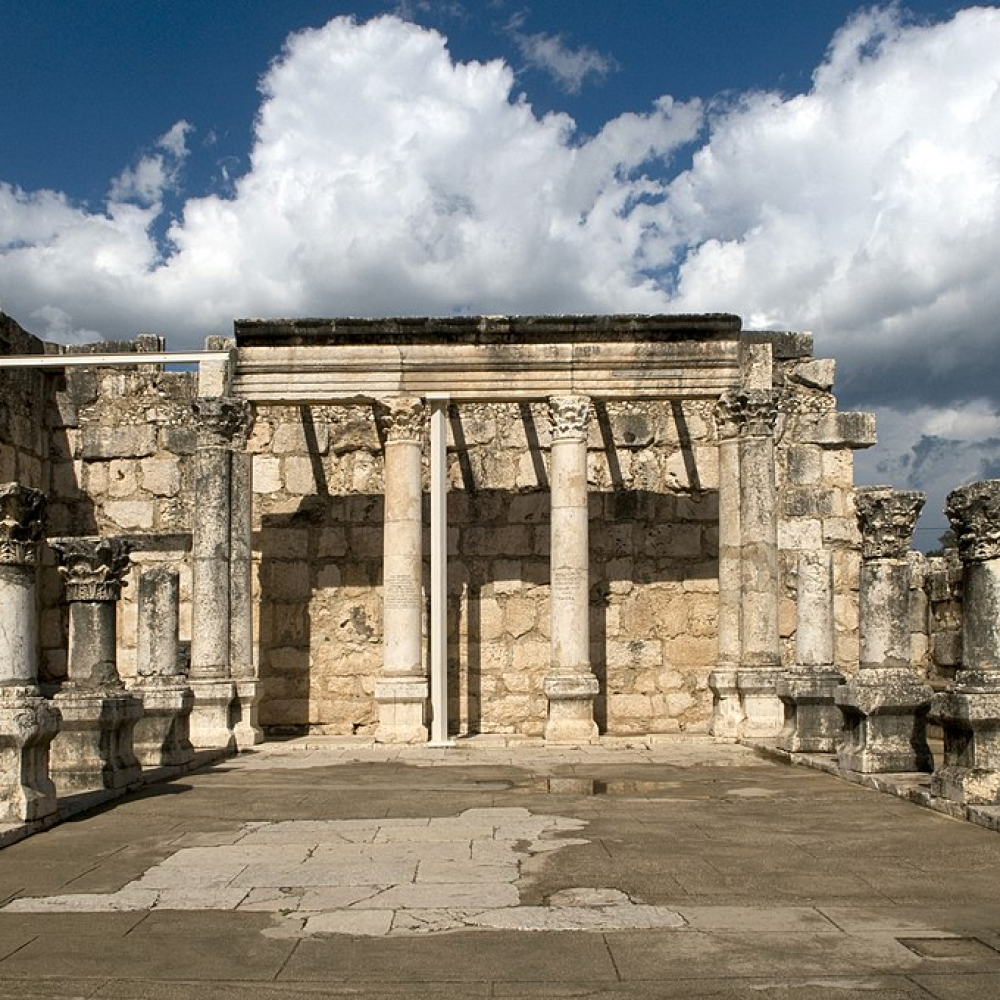
Was a fishing village established during the time of the Hasmoneans, located on the northern shore of the Sea of Galilee. It had a population of about 1500. Archaeological excavations have revealed two ancient synagogues built one over the other. A house turned into a church by the Byzantines is believed to have been the home of Saint Peter.
CAPERNAUM IN THE NEW TESTAMENT
Jesus was born in Bethlehem, brought up in Nazareth, and preached in Jerusalem but it was the significant Galilean Ministry years which he spent in Capernaum and where he performed many of his miracles. Capernaum became his home and the Bible calls it Jesus’ “own city”. Matthew 4:13 tells us that Jesus left Nazareth and went to live in Capernaum after meeting temptation in the wilderness. Here he met James, John, Peter, Andrew all fishermen and Matthew a tax collector, five of his future disciples.
HISTORY OF CAPERNAUM
Capernaum - the end of the Jesus Trail
In Biblical times Capernaum was one of the main trading villages in the Gennesaret area. It was a vibrant and prosperous part of Palestine, home to about 1,500 people many of whom were fishermen. Many travelers, caravans, and traders passed through Capernaum on the Via Maris. It was main trade route connecting Damascus in the north and Egypt in the south. There remains a Via Maris highway mile stone in Capernaum today. The village was thought to have prospered from the 2nd century BC to the 13th century AD when it reverted to a simple fishing village until the 1800’s.
The late establishment of the town explains why Capernaum is not in the Old Testament. The town is deeply significant to Christians as it features prominently in the New Testament.
THE CHURCH AND HOUSE OF PETER
Archaeologists uncovered an early Christian home in Capernaum thought to have been the home of Peter. Jesus cured Peter’s mother-in-law here (Matthew 8:14-16) and is thought to have lived in this house while in Capernaum. This is the site where Christ cured a paralytic who was lowered in through the roof (Mark 2:1-12). After Jesus’ death the home became a place of worship. Several architectural changes distinguish it from other homes. In the 5th century, an octagonal church was built here to preserve the remains of the Insula Sacra. Many inscriptions in Greek, Armenian, Estrangelo, and Latin are on the ancient stones. There now stands a modern hexagonal Franciscan church over the spot thought to have been Peter’s house. There is a glass floor so that you can still see the ancient original church below.
Despite having performed many miracles in Capernaum Jesus was disappointed in the village’s lack of faith and eventually cursed Capernaum. Capernaum is one of Israel’s most sacred Christian pilgrimage sites where believers can sit on the stone benches in the ancient synagogue where Jesus would have sat and walk the streets he would have walked. In 2000 Pope John Paul II visited this sacred Christian site.
 Holy Land Bible Tours.